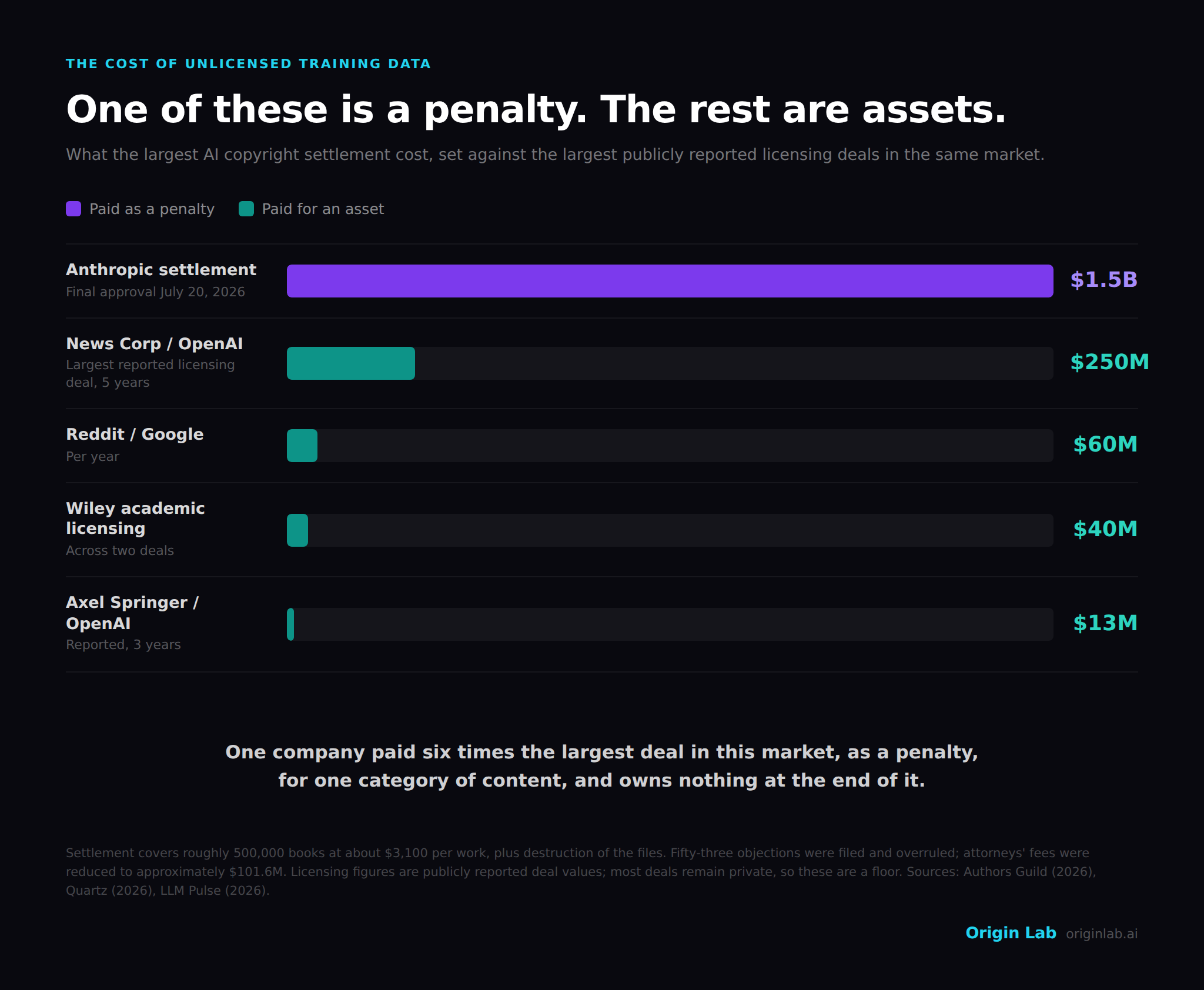
On July 20 a federal judge granted final approval to the largest copyright settlement in American history. One AI company, $1.5 billion, roughly half a million books taken from pirate libraries, at something close to $3,100 per work. Fifty-three objections were filed and all were overruled, and the company has to destroy the files.[1]
The largest publisher licensing agreement anyone has reported publicly is News Corp with OpenAI, at roughly $250 million over five years. Reddit licensed to Google for about $60 million a year. Wiley's academic licensing came to a little over $40 million across two agreements.[2]
The settlement was six times the largest deal this market has produced, paid as a penalty rather than as an acquisition, for one category of content, and it conveyed no rights.
We sell licensed data, so we have an interest in how this reads, but all the figures here come from the courts, the labs, and the published research.
The lawsuits are about how the data was obtained
Companies are not losing because they trained on copyrighted work. They are losing because of how they got it.
Judge Alsup held that training on books a company legally acquired is defensible, and training on books it pirated is not.[3] Meta's case has the same shape: it prevailed on fair use against the authors who sued, and remains exposed on the torrenting.[3] The Anthropic settlement covered books pulled from pirate libraries, and the remedy was destruction of those files.[1]
Buy the material, document the purchase, and this category of exposure largely closes.
A second dynamic has drawn less attention. Fair use weighs whether a use harms the market for the original, and displacing a licensing market that already exists is one form of that harm. Thomson Reuters v. Ross turned on exactly that.[4] Applied to training data, the reasoning carries an expiration date: the defense that nobody licenses this category holds only while nobody does. Licensing for AI training passed roughly $4 billion this year.[2] Every deal signed makes the argument harder for whoever did not sign one.
The costs that never reach the data line
Litigation is what unlicensed data costs when it goes wrong. Two further costs apply whether or not anyone ever files, and one of them is larger.
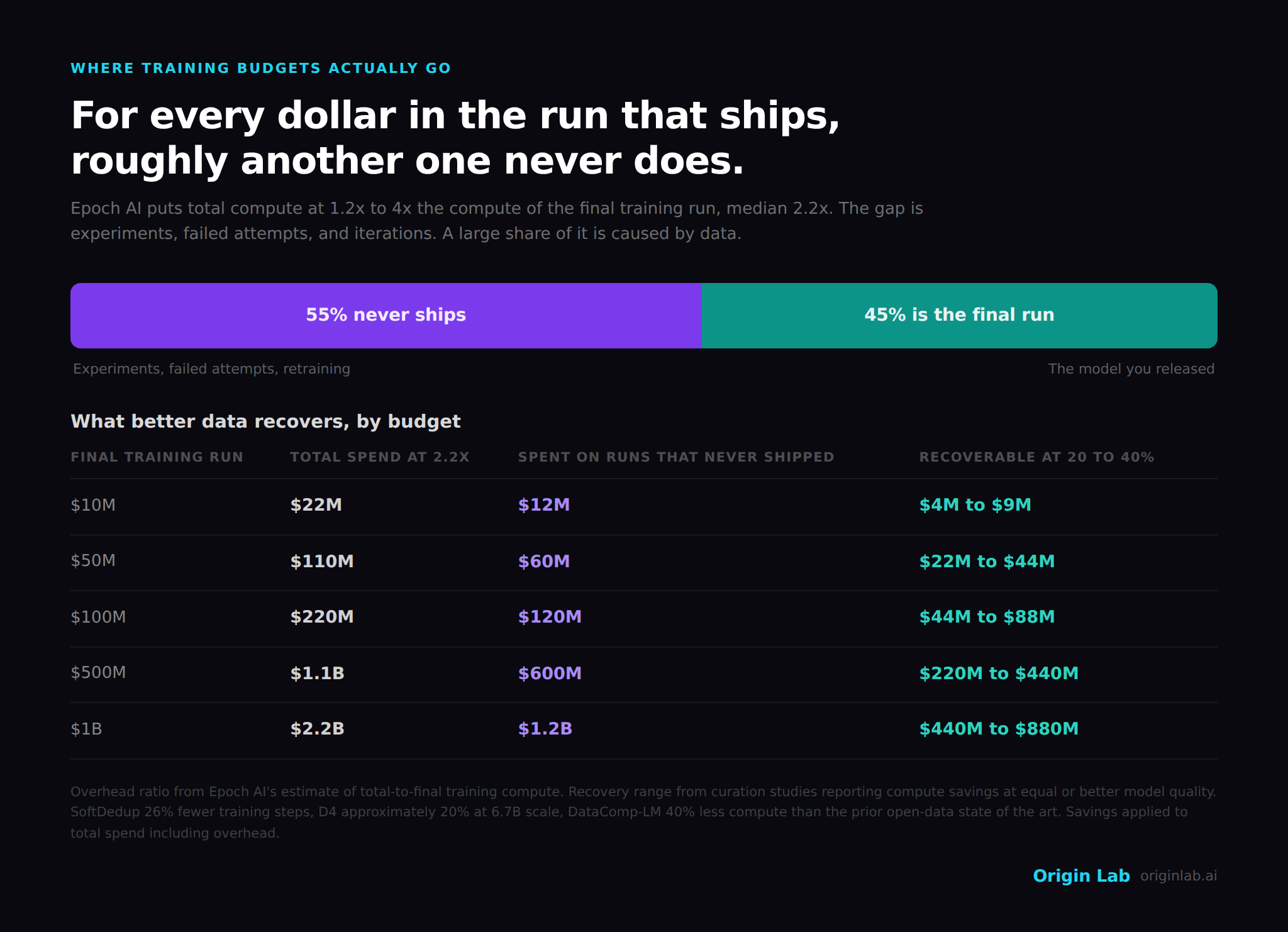
Compute. Training costs have grown roughly 2.4x per year since 2016, and Dario Amodei has suggested individual runs could pass $10 billion this year.[5][6] Epoch AI estimates that total compute spent producing a model runs 1.2x to 4x the compute of the final run, median 2.2x.[5] For every dollar in the run that ships, roughly another goes into experiments and iterations that never become anything.
A meaningful share of that is data: duplication, domain mismatch, contamination found late, and evaluation cycles that cannot isolate a failure because nobody can trace where a sample came from. None of it appears as a line item. All of it appears in the compute bill.
When runs cost single-digit millions, sloppy data was an annoyance. In the hundreds of millions it is a capital allocation failure. At ten billion it is a board problem.
The curation literature converges on 20 to 40 percent compute savings for equal or better model performance.[7][8][9][10] On a $100 million budget that is $20 to $40 million. On a billion, $200 to $400 million.
DeepSeek V3 is the frontier-scale version of the same finding. Performance comparable to leading closed models at $5.6 million in total training cost, on 14.8 trillion carefully assembled tokens, with a pre-training run their own report calls remarkably stable.[11] A team working under hardware export restrictions reached the frontier partly by spending carefully on what went in.
People. You probably already know this one. Rights holders work with companies they trust, and most large catalog owners now have a view on which is which. The part that surprised us is recruiting: provenance comes up unprompted in nearly every senior candidate conversation we have, and it did not a year ago. World models need taste and real familiarity with how environments behave, which is expertise concentrated among people who build worlds for a living. On both counts, that is the same group of people.
World models raise all three
Video training costs 10 to 100 times what text costs, and world models more still, because they must learn how an environment behaves under action rather than how a frame looks. NVIDIA trained Cosmos on 9,000 trillion tokens drawn from 20 million hours.[12]
The sourcing problem is worse too, because much of what these models need was never on the internet. Scrape a gameplay stream and you get pixels: no scene depth, no camera pose, no object mass or velocity, no record of whether two things touched or what existed behind the player, no key the human pressed a hundred milliseconds before the outcome. For a model learning how a world responds to action, those are the labels.
NVIDIA named demonstration data the limiting input for physical AI at GTC in March, inside a roadmap that already assumes heavy synthetic augmentation.[13] World Labs published robot policy results in July and concluded that closing the distance between a demo and a deployable robot needs more grounded experience than a team can gather on hardware.[14]
Six questions
What happens to the deployed model if the data turns out to be a problem? The remedy regulators have already used is deletion of the model, not only the data. The FTC ordered it against Cambridge Analytica, Everalbum, WW International, Edmodo, and Rite Aid between 2019 and 2023.[15][16] Those were privacy actions, and no court has yet ordered a foundation model destroyed over training data. The remedy exists, it has been used, and almost nobody has priced it.
Can we trace a sample back to its source? Provenance is a debugging tool before it is legal insurance. A team that can attribute a failure to source quality, label quality, or domain mismatch corrects it directly. A team without that trace finds the problem by running more experiments.
When we ask how good the training data is, do we get a measurement or a size? Scale without evaluation is how a company spends nine figures on a run built over duplicated, noisy, contaminated content. An answer given in terabytes describes volume, and volume is not what the research says drives performance.
Is there better data we are not buying because the sticker price is higher? Licensed structured data costs more per unit and can still cost less per unit of capability, because fewer hours are required and the retraining cycle is shorter.
Is procurement measuring the right thing? Cost per terabyte and cost per token both ignore how much compute a corpus consumes to reach a target capability, which is where the money actually goes.
What is the refresh strategy? Models trained on static corpora degrade as the domain moves. Who supplies updated coverage, on what terms, and how fast are questions to settle before committing to a corpus.
The Origin Lab corpus, what we measured, and how to test it
Origin Lab captures inside game engines, under license, across more than fifty titles from twenty-plus publisher partners. Ten modalities per hour on one clock, including per-pixel depth measured by the engine and input at hardware timing. Every hour is human-played on a directed mission, QA'd twice, and carries a rights trail back to the company that owns the world. We are approaching 100,000 hours at roughly 10 petabytes, expect to cross it by the end of September, and have one major frontier lab under contract with buyer conversations opening now.
This month we ran our first study on it.
A training set one thousand times smaller than the largest public depth dataset, labeled from ground truth measured inside the game engine, produced more accurate models on the content it covered.
We trained depth models on 48,000 frames from 98 sessions across ten titles. Tested on held-out frames against three state-of-the-art baselines, ours came out ahead in domain, and training the same architecture on our data cut error by about a factor of three and a half. It came out strong outdoors and weak indoors, because the training subset held no indoor environments, which makes coverage something a buyer specifies rather than hopes for.
A private preview is open at app.originlab.ai/data, and a sample set can be downloaded on request. Open a session, look at the modalities in the mosaic, and run your own evaluation.
Next week, more on the data with our CTO: the full specification, what it is not good for, and the seven questions our ML team is working through. The study itself lands with the public dataset on Hugging Face. Follow Origin Lab on LinkedIn to catch both.
The companies that lead the next era of AI will probably not be the ones that spent the most on compute. More likely they will be the ones that got the most capability out of each dollar, and that has always started with what goes into the model.